
WeldExp welding engineering modules support the everyday tasks of technology planning, preliminary technical verification and decision preparation. The calculators are not isolated spreadsheets: they operate within a shared system, can use data from the Base Material Library and Welding Material Library, and their results can connect to technology documentation, qualifications and other WeldExp modules.
Guided data entry, clear result sheets and visual diagrams are intended to make calculation processes easier to review, more consistently documented and simpler to verify later.
The modules are engineering aids. Results must always be evaluated in the context of the actual task, applicable technical requirements, manufacturer requirements and the decision of the responsible specialist.

Pre-Heat Temperature Calculator
Module for estimating preheat temperature of ferritic steels
The Pre-Heat Temperature Calculator (PRHTC) supports determination of preheat temperature for arc welding of ferritic steels and preliminary engineering assessment of hydrogen-assisted cold-cracking risk.
Main functions
- CET determination: the carbon equivalent used by the calculation can be determined from the available chemical composition.
- Specific heat-input calculation: the Q value can be calculated from the welding parameters and the efficiency factor of the selected process.
- Combined-thickness handling: the d value used by the calculation can be determined from joint geometry and material thicknesses.
- Diffusible-hydrogen input: the HD value can be entered directly from inspection-certificate or welding-consumable manufacturer data.
- Preheat-temperature estimate: the estimated preheat temperature is calculated from the combined effects of CET, Q, d and HD using the Uwer–Höhne relationship.
Application: preliminary welding-procedure planning for ferritic steels, particularly assessment of hydrogen-assisted cold-cracking risk and preheating requirements.
The application range of the Uwer–Höhne relationship is CET 0.20–0.50%, d 10–90 mm, HD 1–20 ml/100 g and Q 0.5–4.0 kJ/mm.
Source: Uwer, D.; Höhne, H. (1991): Characterisation of the cold cracking behaviour of steels during welding.
PRHTC Screenshots
Screenshots of Preheat Temperature Calculator.
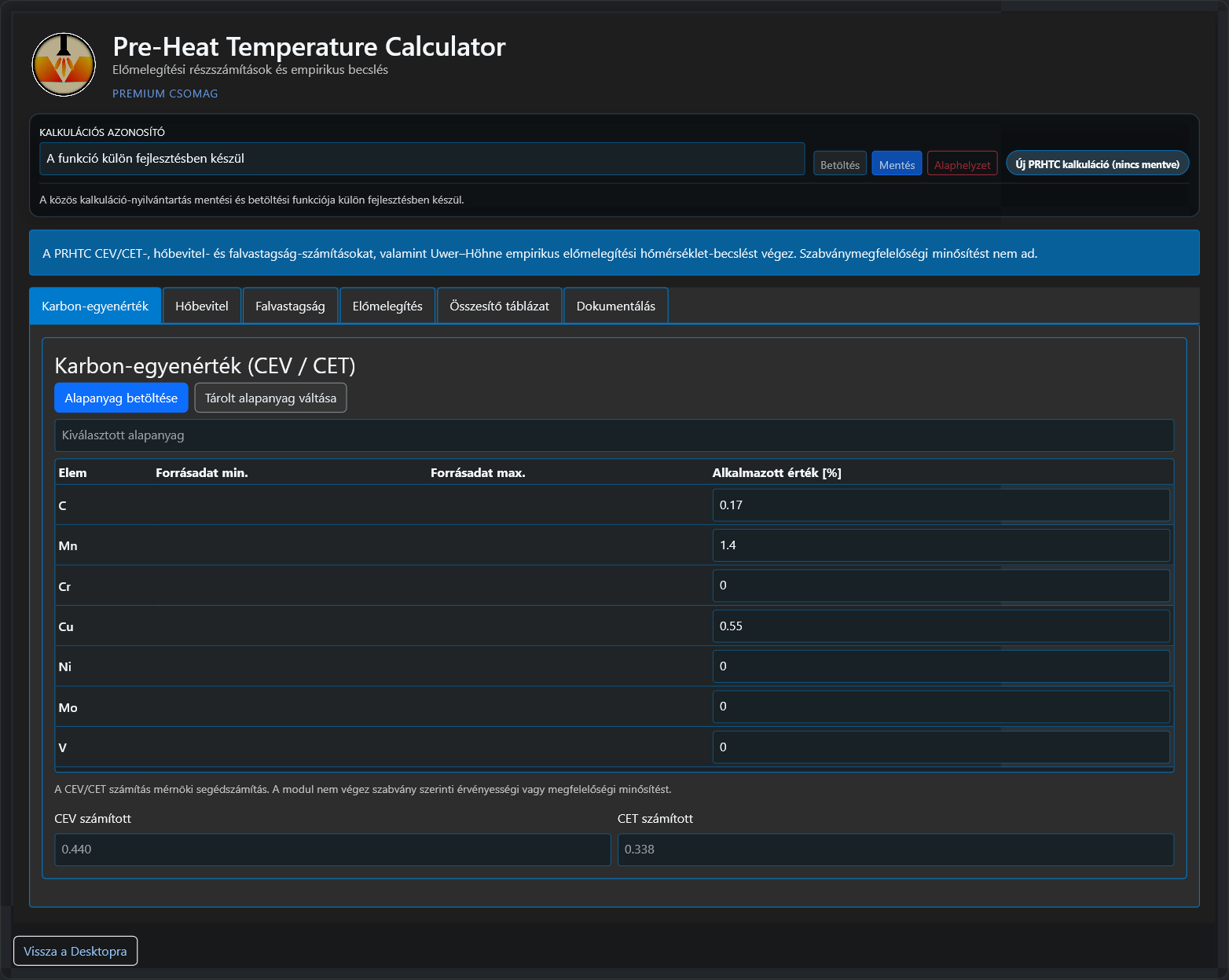
CEV and CET carbon-equivalent calculation in the PRHTC module. 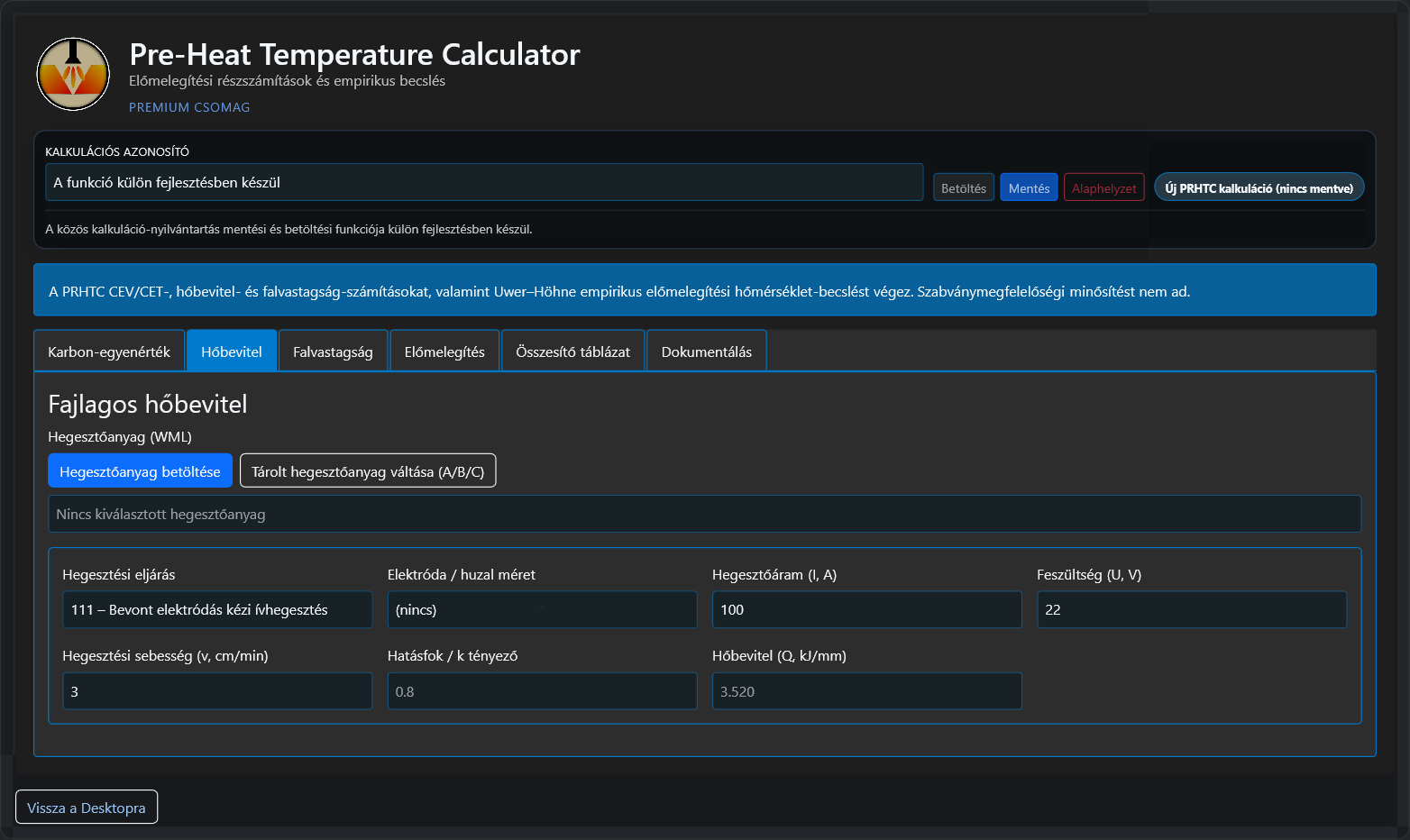
Specific heat-input calculation data in the PRHTC module. 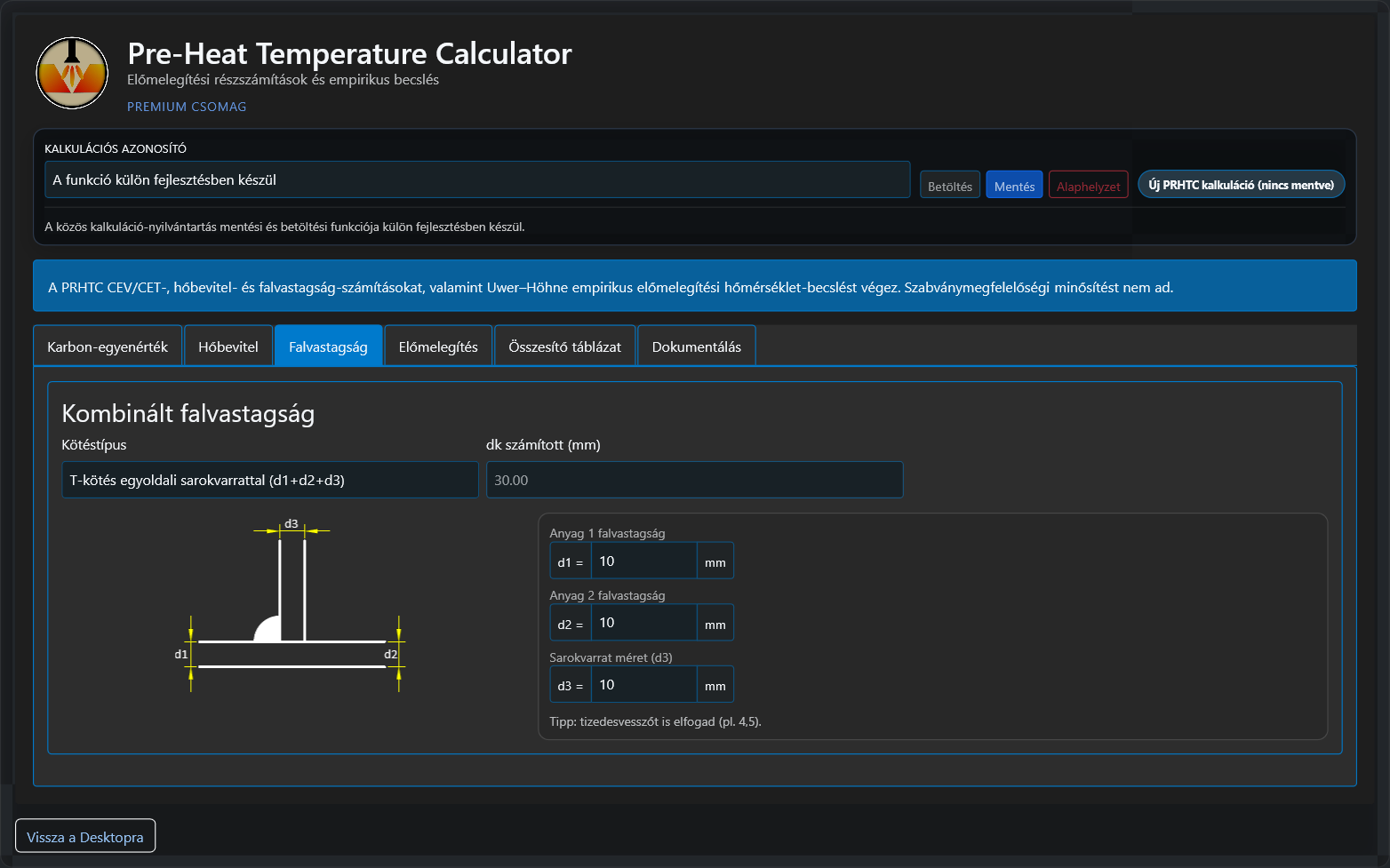
Joint type and combined thickness in the PRHTC module. 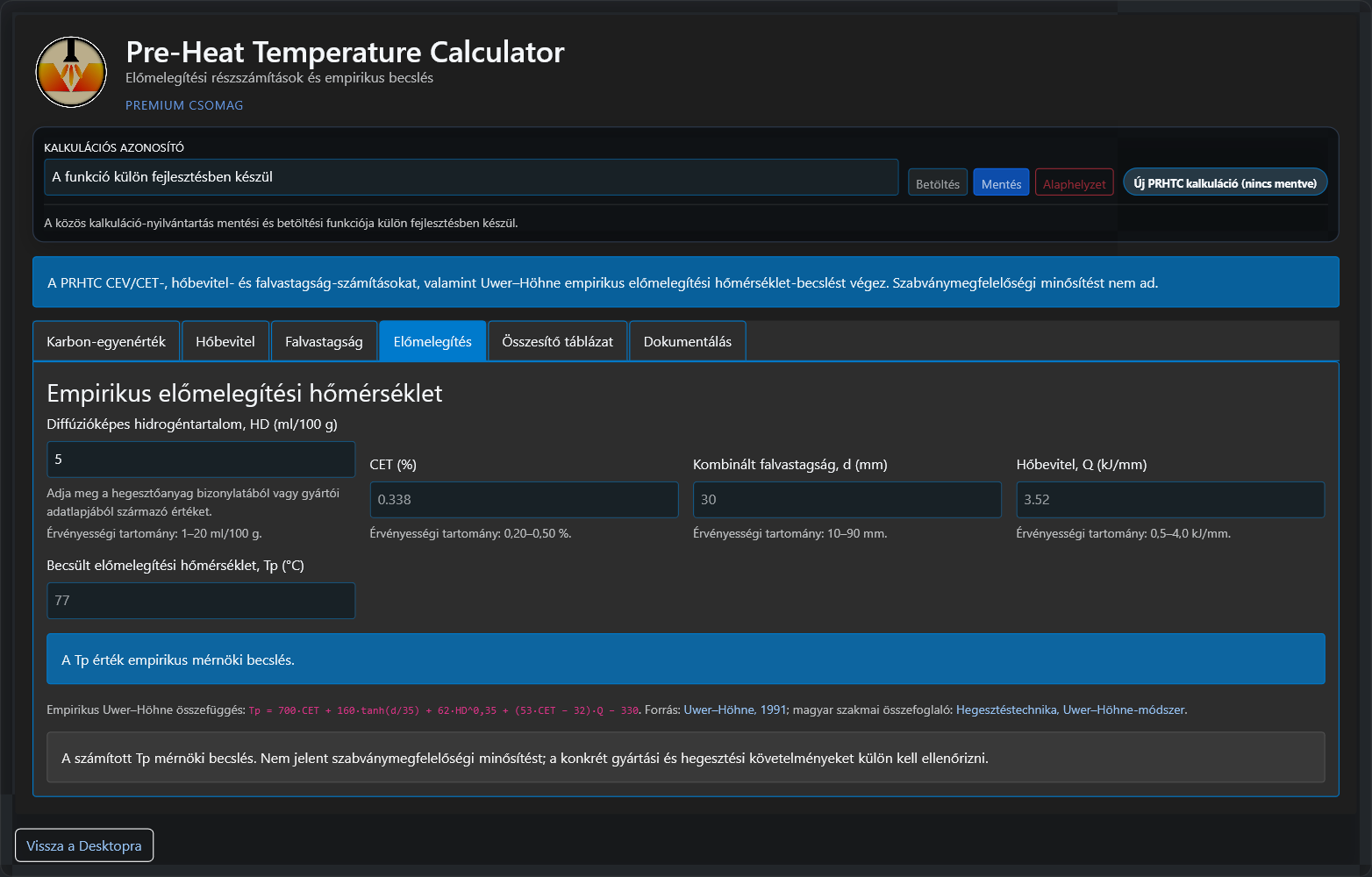
Empirical preheat-temperature estimation in the PRHTC module. 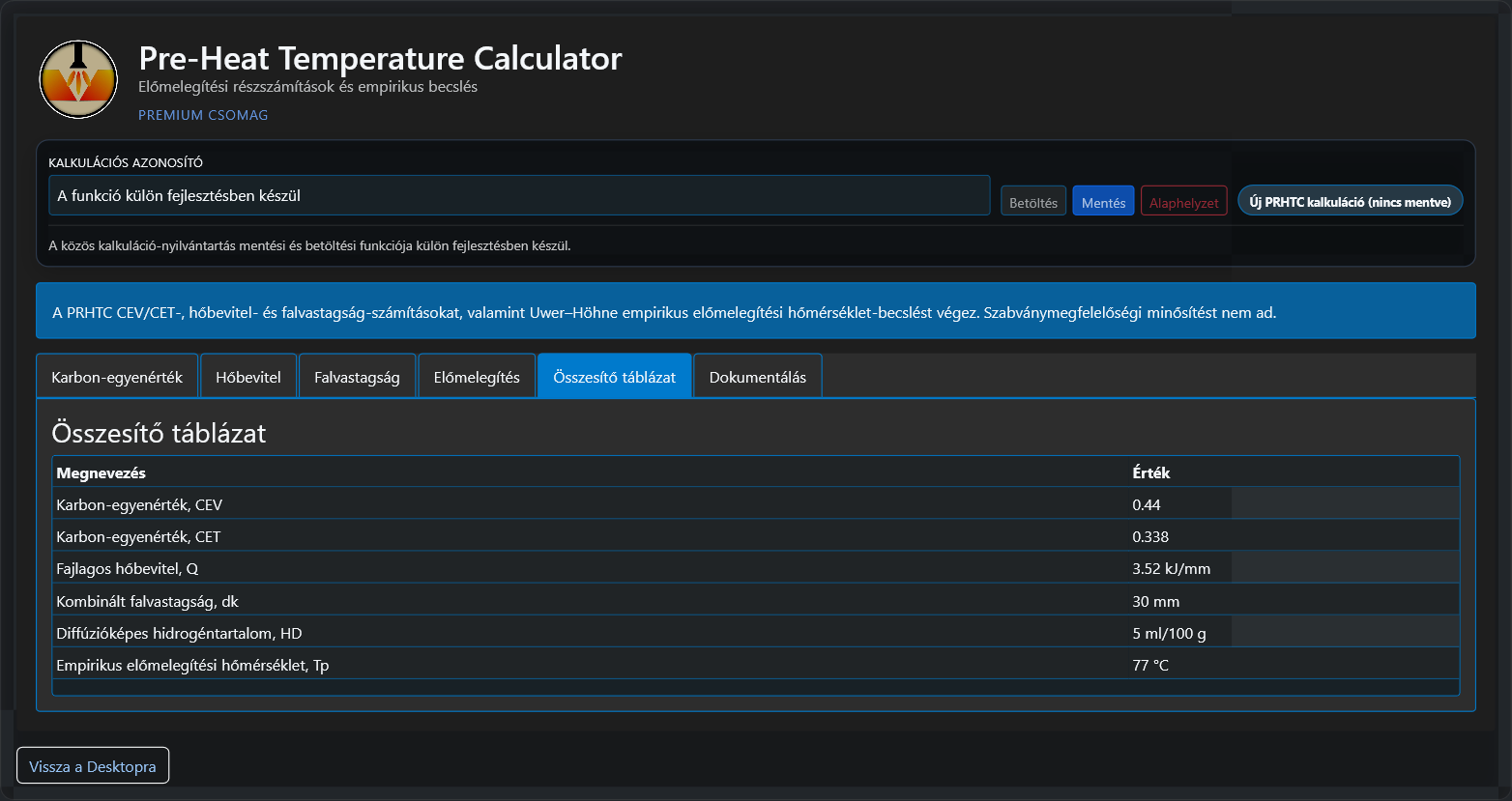
Summary results of the PRHTC calculation. 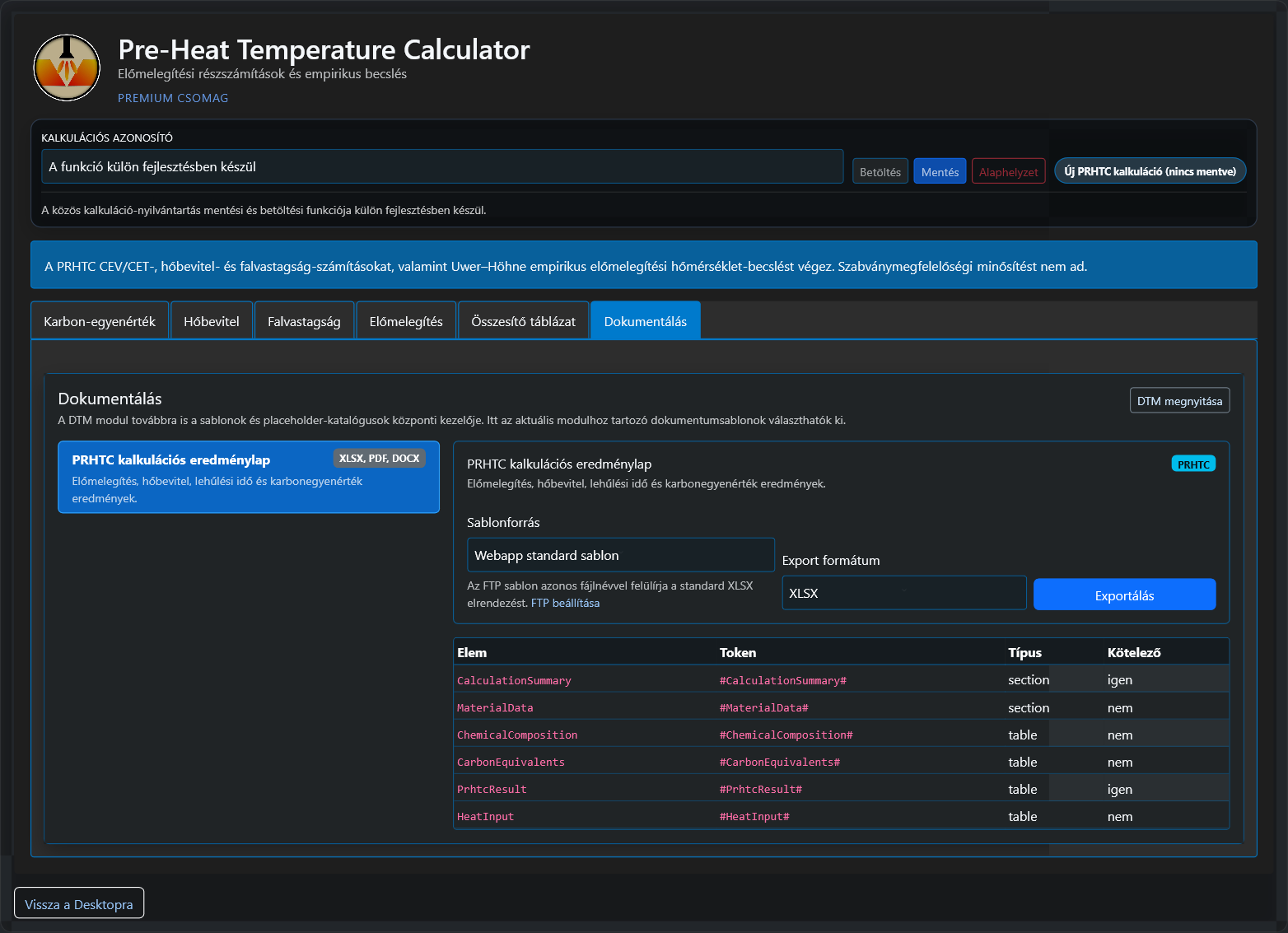
Documentation and export interface for the PRHTC calculation result sheet.

Weldability Calculator
Module for assessing weldability of high-alloy, corrosion-resistant and heat-resistant steels
This advanced module supports preliminary planning and checking of arc-welding technologies for corrosion-resistant, highly alloyed and heat-resistant steels.
It is intended for specialists who need to create quality, safe joints with these critical base materials, whether in chemical, energy or food-industry applications.
Main functions
- Microstructure estimation: the program predicts the microstructure that may form in the weld from the specified base-material and welding-consumable combination.
- Chromium- and nickel-equivalent calculation: equivalents can be determined separately for the base material, welding consumable and expected weld metal.
- Ferrite-number calculation: the module supports preliminary evaluation of the expected delta-ferrite content.
- Dilution-ratio handling: expected weld composition can be estimated from the specified dilution ratio of base material and welding consumable.
- Cracking-sensitivity assessment: sensitivity of the joint to hot and cold cracking can be examined as a function of welding conditions and compositions.
- Schaeffler and DeLong diagrams: calculated results are automatically placed on the diagrams to make visual evaluation easier.
- Calculations based on technical literature: the built-in algorithms are developed from welding-technology literature and university course material.
- Summary result sheet: calculated values and diagram results can be checked in one common summary view.
WAC Screenshots
Screenshots of Weldability Calculator.
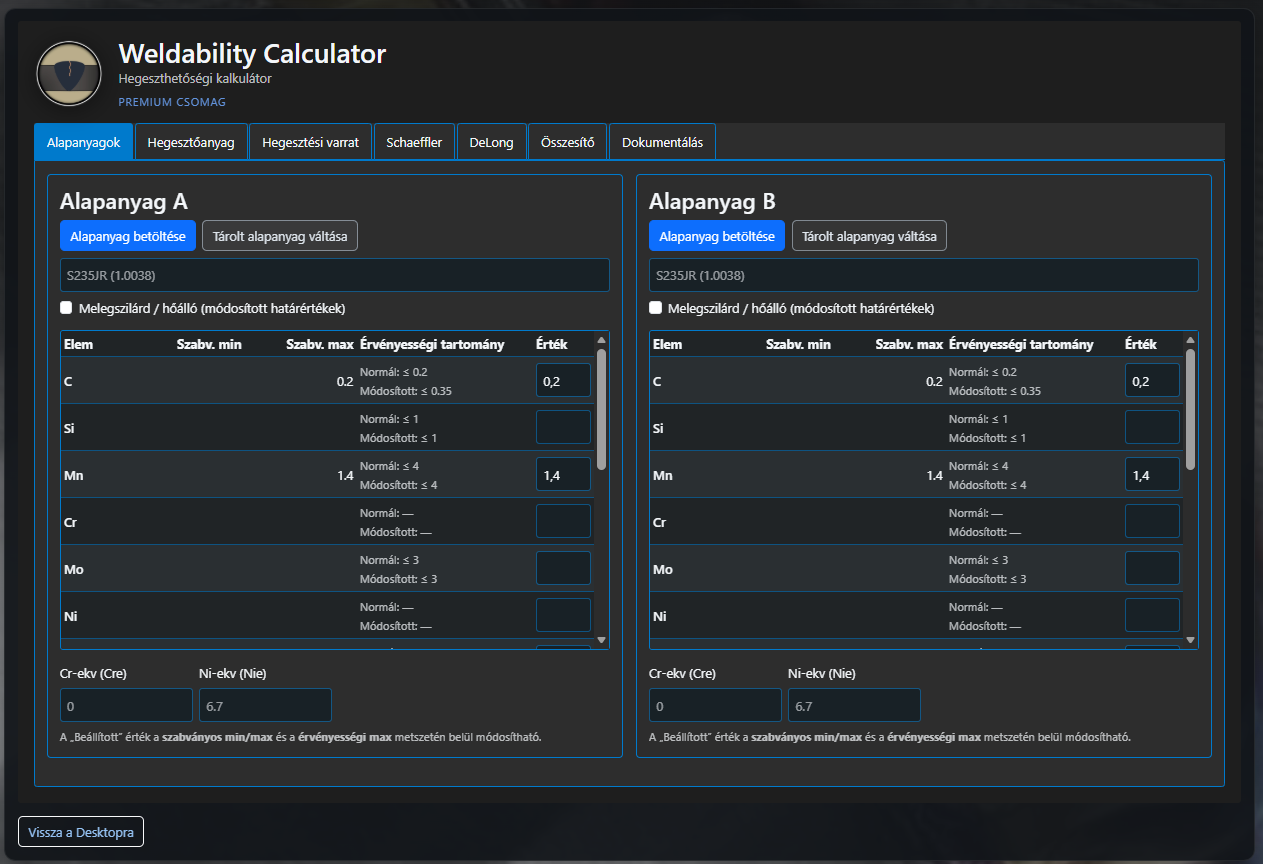
WAC application – showcase image 1. 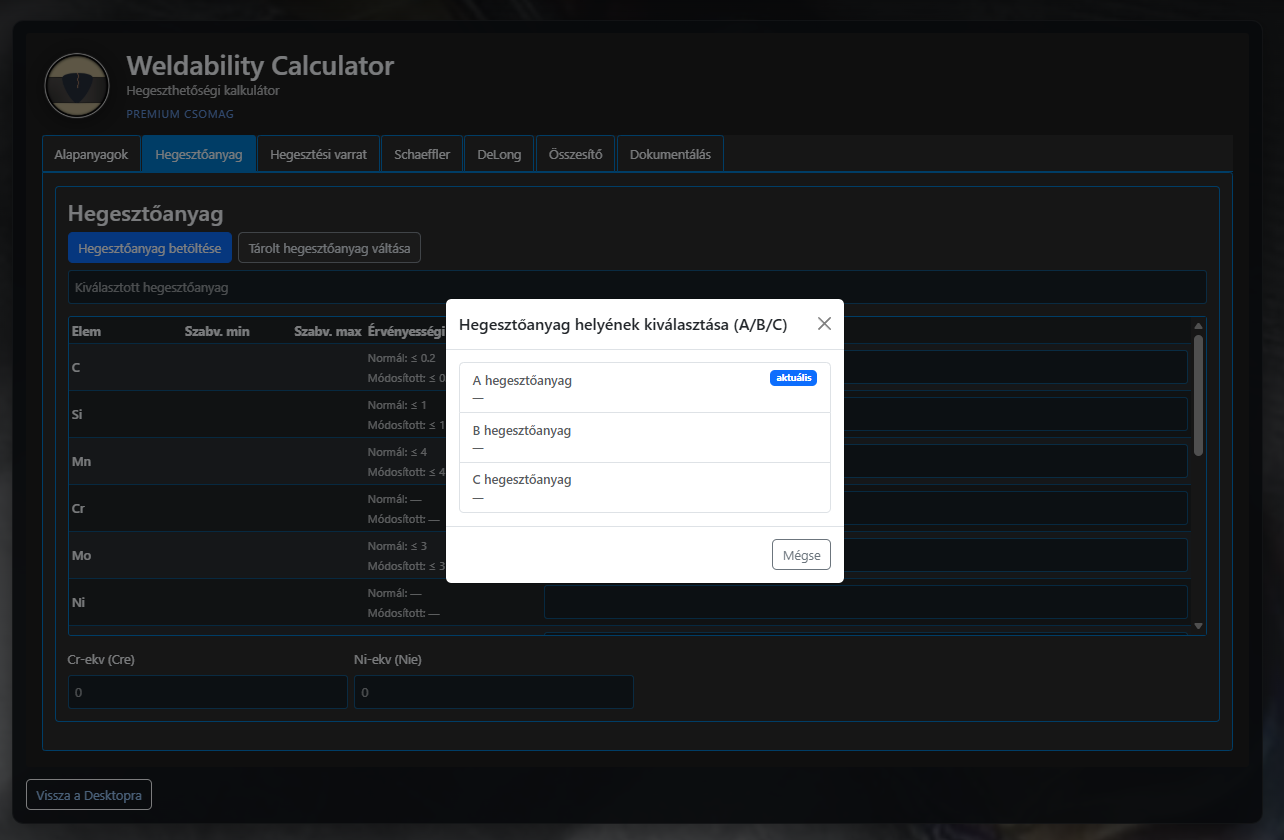
WAC application – showcase image 2. 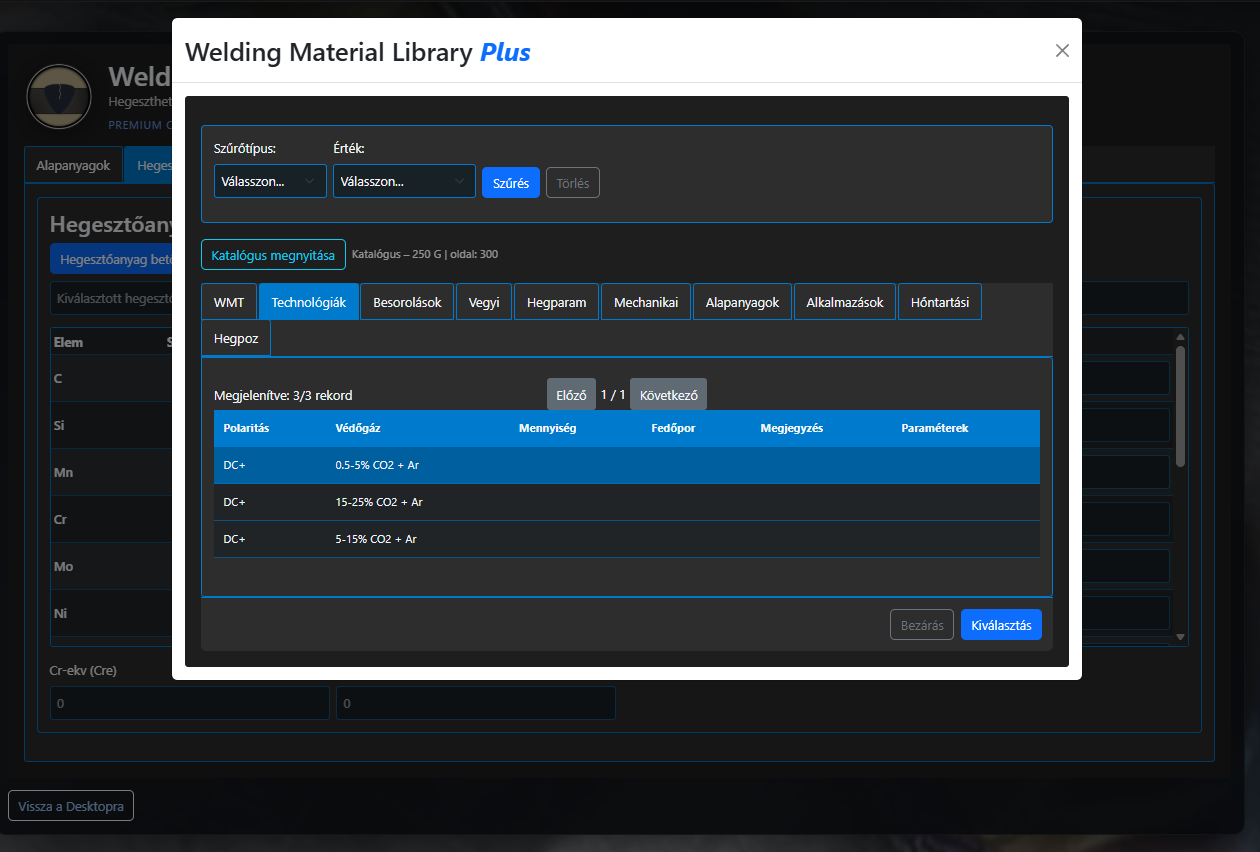
WAC application – showcase image 3. 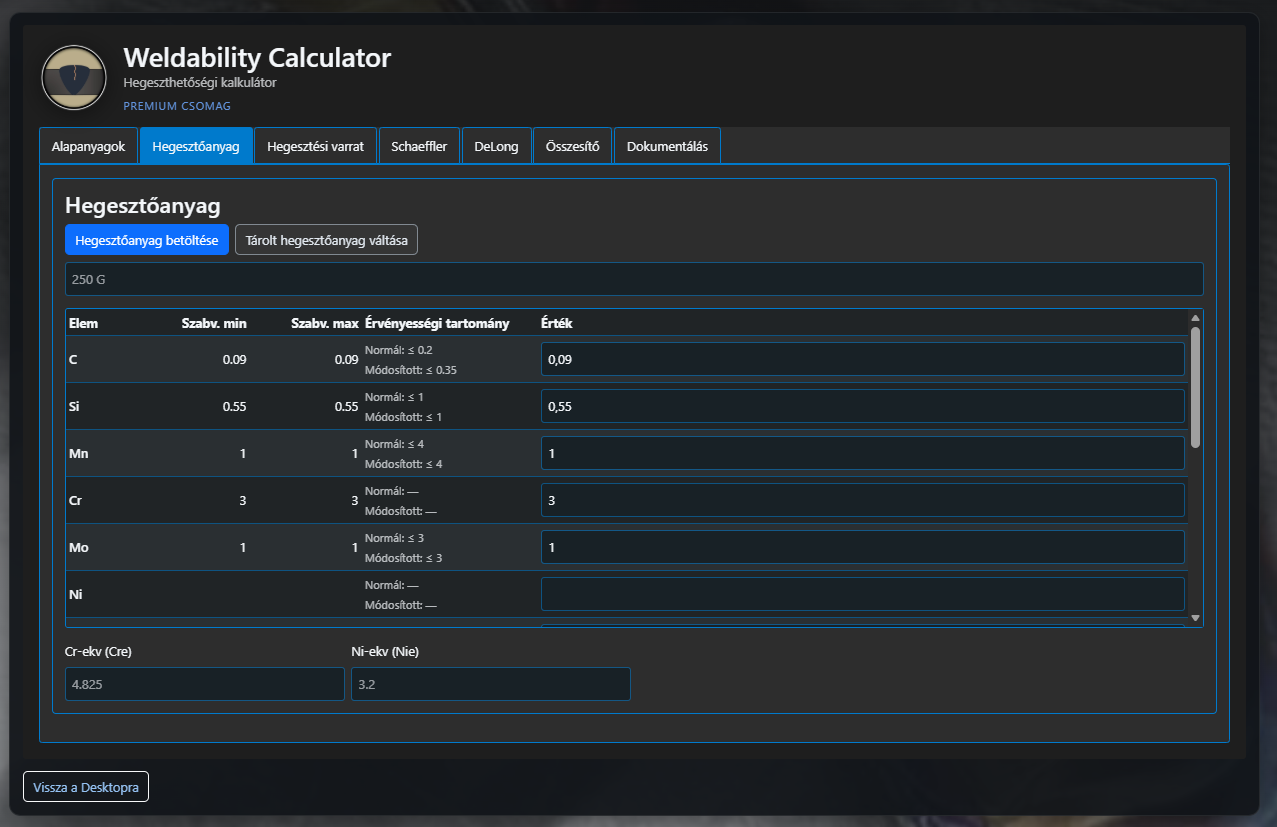
WAC application – showcase image 4. 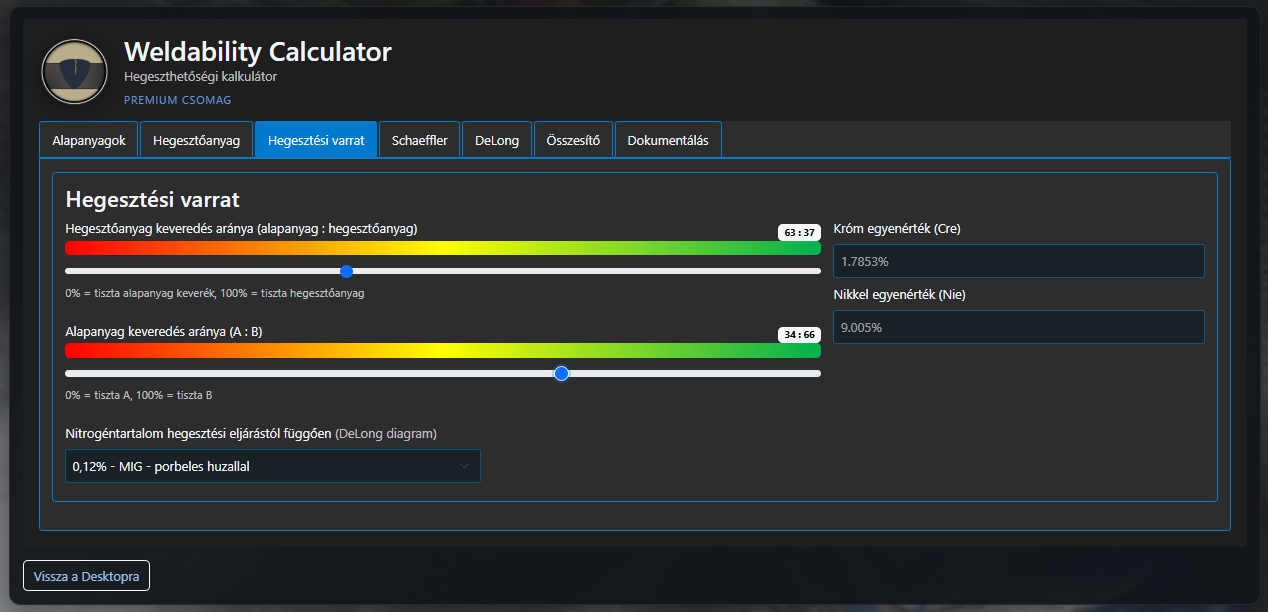
WAC application – showcase image 5. 
WAC application – showcase image 6. 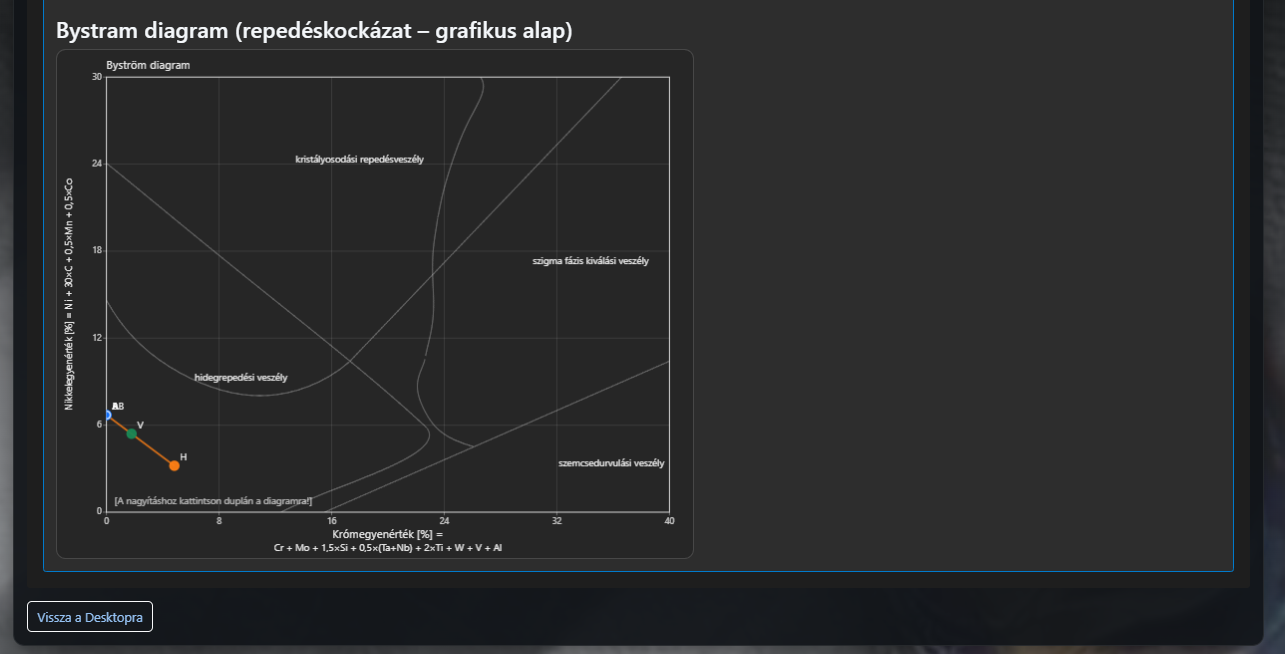
WAC application – showcase image 7. 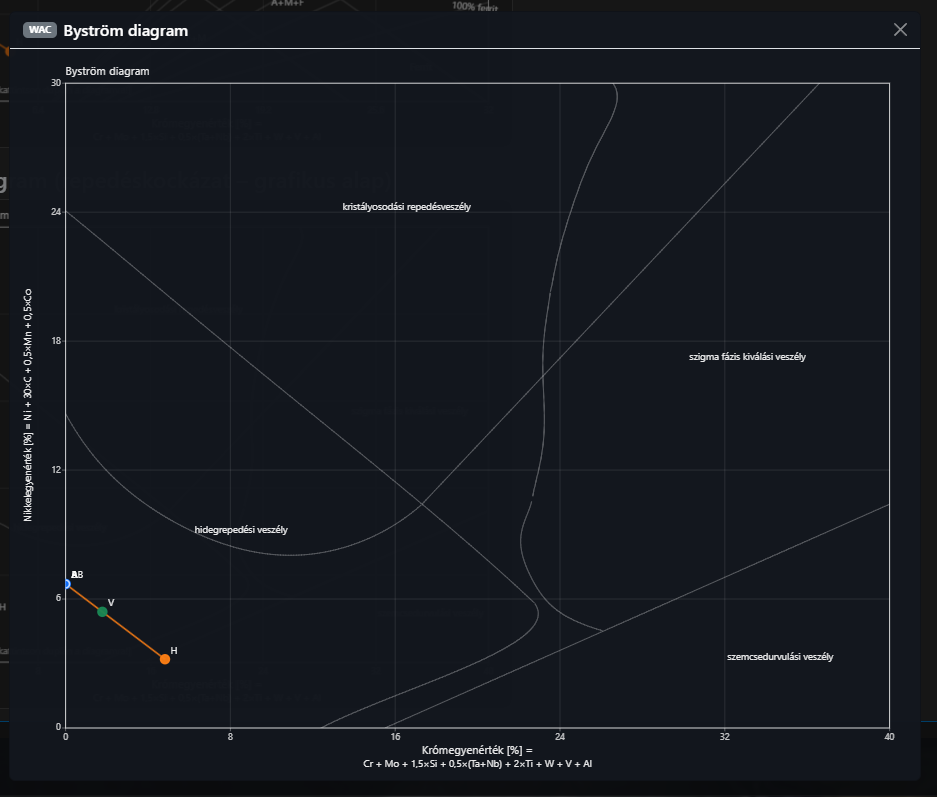
WAC application – showcase image 8. 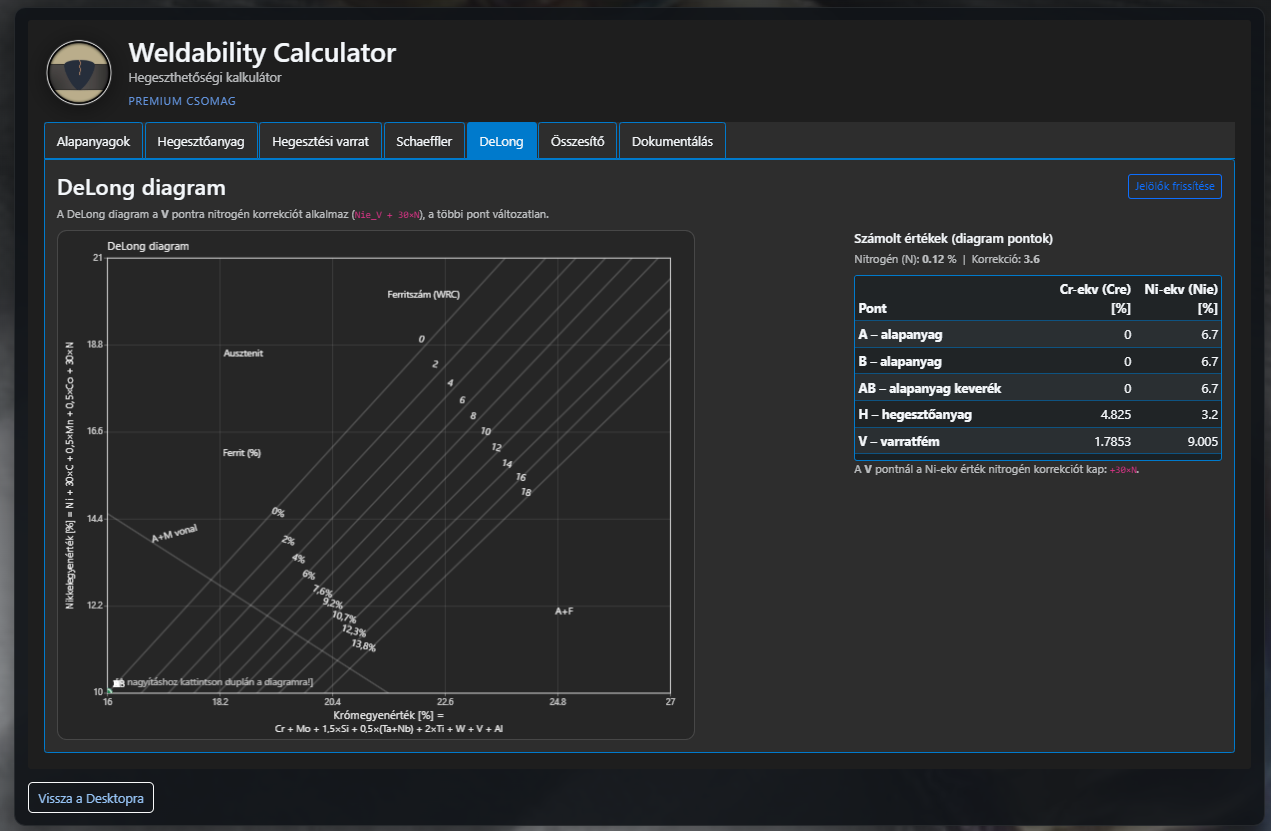
WAC application – showcase image 9. 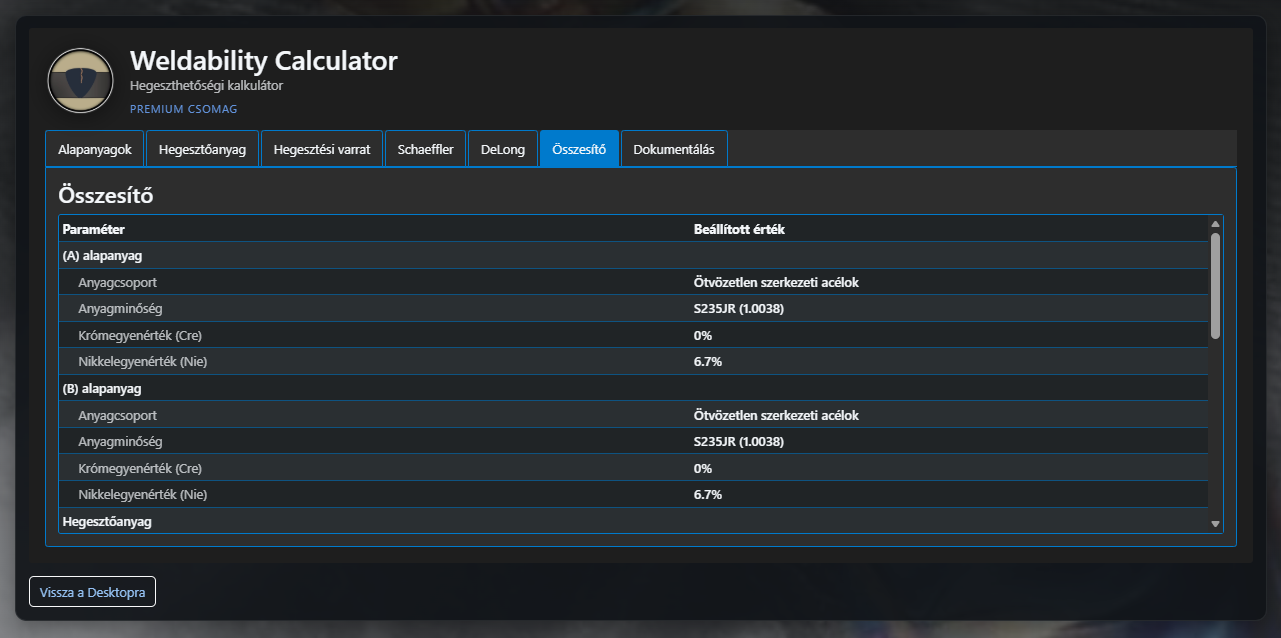
WAC application – showcase image 10. 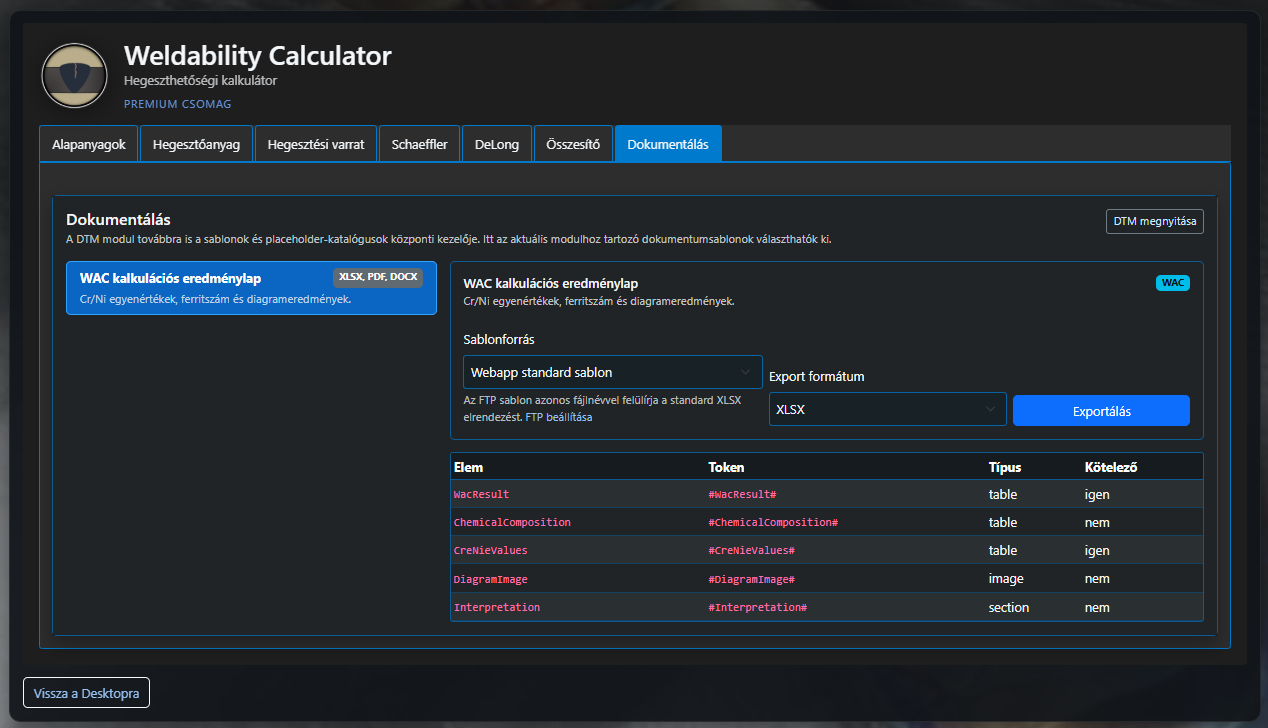
WAC application – showcase image 11.
Weld Geometry Calculator
Module for calculating weld geometry and stress state of welded joints
The Weld Geometry Calculator (WGC) supports engineering evaluation of welded-joint geometry, cross-sectional properties and the stress state resulting from the specified loads.
Main functions
- Joint type and weld geometry: calculations can be adapted to the joint configuration and entered dimensions.
- Geometry calculations: weld cross-section, volume and other geometry data required for calculation can be determined.
- Stress calculation: characteristic stress components can be determined from the specified loads.
- Equivalent-stress evaluation: results can be evaluated using von Mises, Tresca and maximum principal stress criteria.
- Optional comparison limit: when an MPa comparison limit is entered, the module also calculates utilisation and comparison data; without a limit it presents the calculated stress results directly.
- Connection to other calculators: calculated geometry data can be used, for example, by Welding Cost Calculator for material-demand and cost estimation.
Application: preliminary geometrical sizing of welded joints, comparison of loading variants and engineering review of the calculated stress state.
WGC Screenshots
Screenshots of Weld Geometry Calculator.
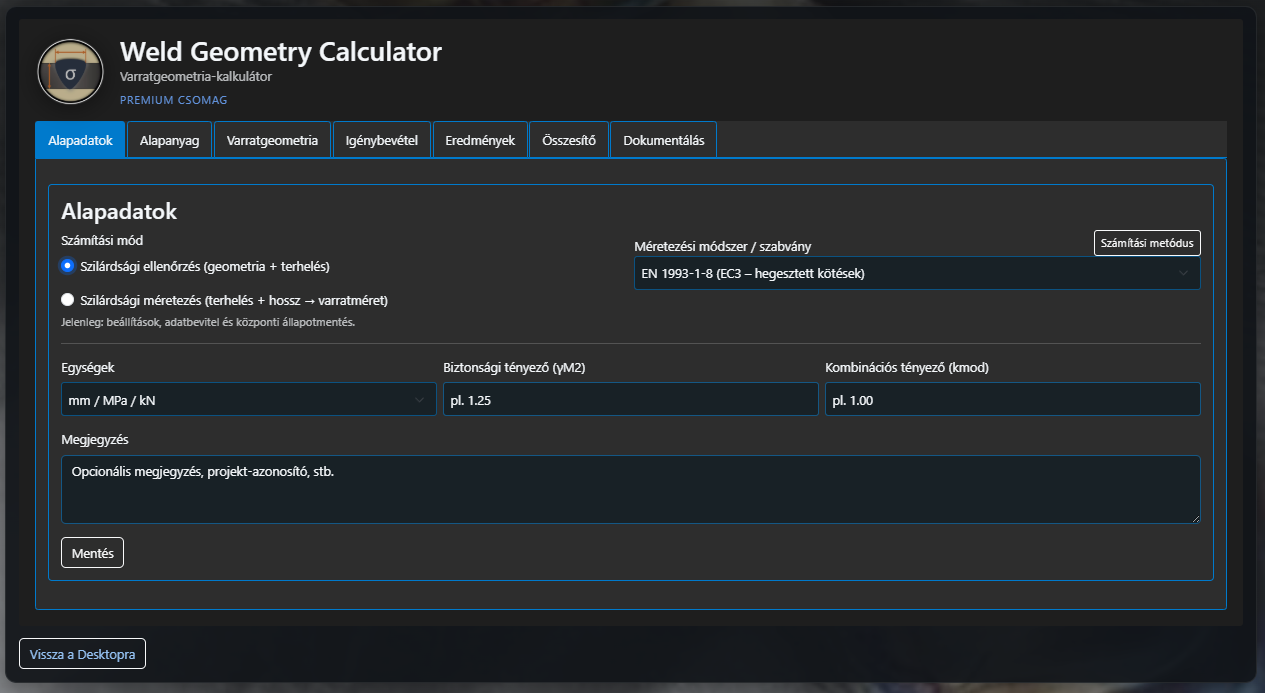
WGC application – showcase image 1. 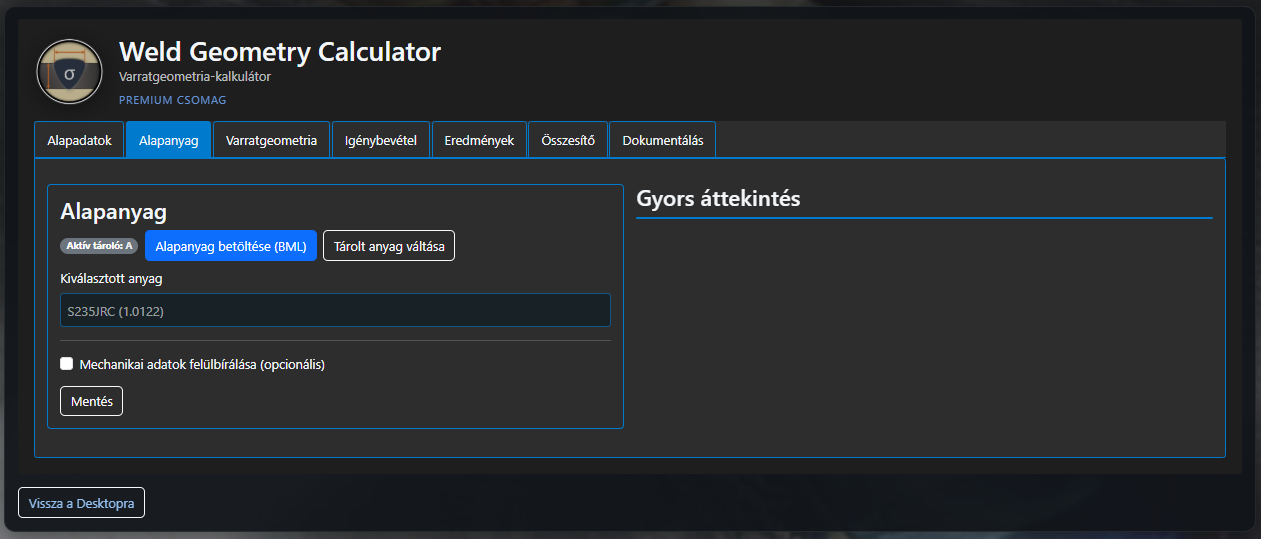
WGC application – showcase image 2. 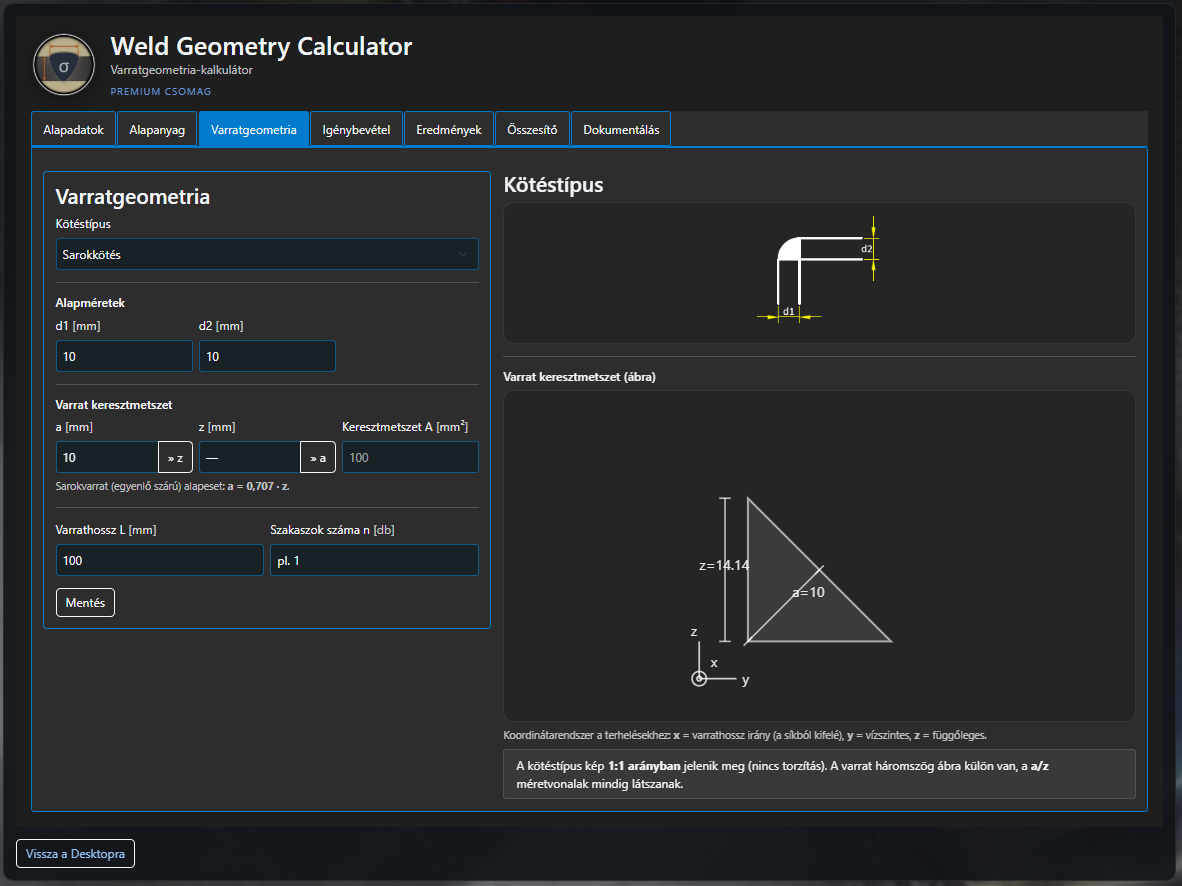
WGC application – showcase image 3. 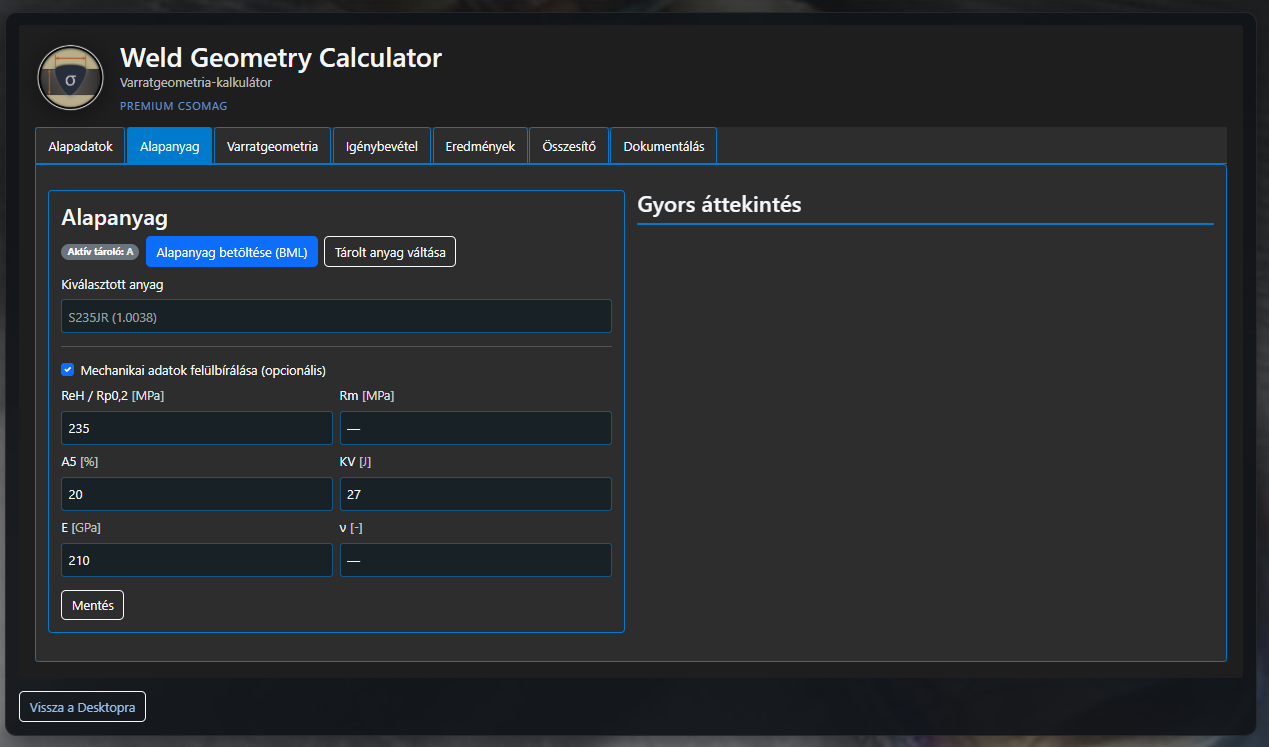
WGC application – showcase image 4. 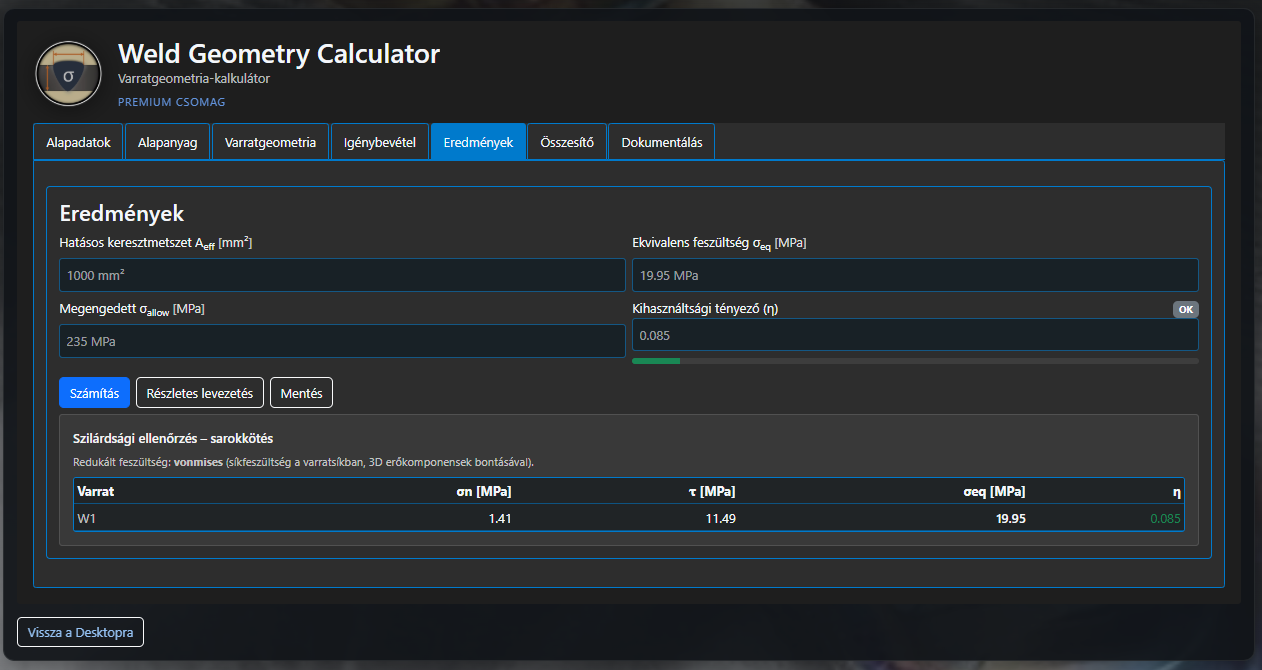
WGC application – showcase image 5. 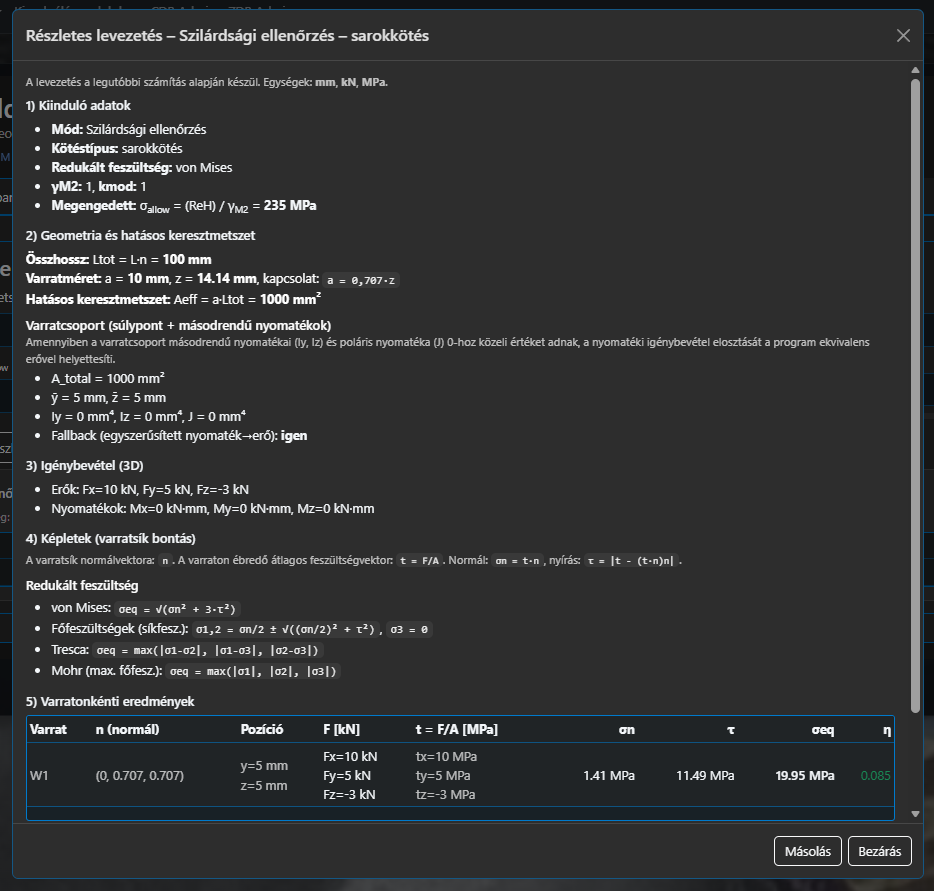
WGC application – showcase image 6.

Welding Qualification Calculator
Module for checking relationships between WPS, WPQR, testing and personnel qualifications
(under development)
Conformity of a welding task does not depend on a single document. An appropriate WPS is required, together with a qualifying WPQR, the prescribed test results and a welder whose qualification range covers the work to be performed.
Welding Qualification Calculator helps review these interrelated data. The module is intended to identify mismatches between documents and authorizations before production begins.
The program does not replace the decision of the responsible welding coordinator, but displays qualification ranges, test states and possible deficiencies in a shared checking interface.
Main functions
- WPS and WPQR comparison: it can be checked whether the qualification range of the selected WPQR covers the technology defined in the WPS.
- Review of test results: the state and conformity of related M-Test examinations can be displayed in a common summary.
- Welder-qualification checking: welder authorizations can be compared with joint type, process, material and other technology requirements.
- Identification of deficiencies: the module indicates when a document, test or qualification item required for a decision is unavailable.
- Unified qualification summary: data from different modules is shown on one clear result sheet.

Welding Cost Calculator
Module for estimating material, time and cost requirements of welding work
(under development)
The cost of a welding task is not determined only by the price of the welding consumable. Weld size, welding process, material loss, shielding-gas consumption, arc time, preparation and required labour time all affect the final result.
Welding Cost Calculator creates a production estimate from these data. Starting from weld geometry, the module determines the required material quantities and assigns time and cost data to them.
The calculation can be useful not only for preparing quotations. It can also help compare different technology variants, check required inventory in advance and plan production resources.
Main functions
- Import of weld data: required geometrical data can be taken from Weld Geometry Calculator results or entered manually.
- Determination of welding-consumable demand: required mass, wire length, electrode count and process reserve can be calculated.
- Auxiliary-material calculation: quantities of shielding gas, flux and other consumables can also be included.
- Time estimation: preparation, intermediate operations, cleaning and machine time can be handled alongside arc time.
- Inventory check: calculated demand can be compared with quantities registered in Inventory Manager.
- Cost summary: material, labour and machine costs, together with the total estimated cost, can be shown separately.
Post Weld Heat Treatment Calculator
Module supporting the planning of post-weld heat-treatment cycles
(under development)
Post-weld heat treatment is not simply a matter of setting a prescribed temperature. Heating rate, holding time, treated zone and controlled cooling can all influence the properties of the joint.
Post Weld Heat Treatment Calculator brings together planning of these technology steps. Based on base material, welding consumable, dimensions and related documents, the module helps assemble the heat-treatment cycle.
The resulting plan clearly shows the main heating, holding and cooling data and indicates when the entered values contain a difference that requires technical review.
Main functions
- Use of material data: technical data for the base material and welding consumable can be used when planning the cycle.
- Definition of holding conditions: heat-treatment temperature and required holding time can be managed.
- Heating and cooling planning: permitted rates can be specified and checked.
- Review of the complete cycle: individual stages of heat treatment are displayed in a common time-temperature summary.
- Document verification: the planned cycle can be compared with heat-treatment data recorded in WPS and WPQR documents.

Cast Iron Welding Calculator
Module supporting selection of welding and repair technology for cast-iron components
(under development)
Repair welding of cast iron differs from welding conventional structural steels. The exact type of base material, graphite form, alloy content, component restraint and heat dissipation all determine which repair technology can be applied safely.
Cast Iron Welding Calculator supports systematic evaluation of these conditions. The module helps identify the nature of the material, recognize expected metallurgical risks and select a repair strategy.
Main functions
- Evaluation of cast-iron type: possible material groups can be narrowed down from entered material and composition data.
- Use of the Mauer diagram: graphical evaluation of chemical composition helps assess the expected material structure.
- Development of a repair strategy: main considerations for cold, semi-hot and hot welding approaches can be compared.
- Presentation of cracking risk: the module separately handles risks arising from hardening, thermal stress and brittleness of the base material.
- Technology guidance: the summary also contains considerations related to welding-consumable selection, preheating and cooling.
Sigma Phase Control Calculator
Module assessing sigma-phase formation risk
(under development)
The advantageous properties of corrosion-resistant and duplex steels can deteriorate significantly if undesirable sigma phase forms during production or heat treatment. In addition to composition, the risk is influenced by how long the workpiece remains in the critical temperature range.
Sigma Phase Control Calculator supports combined assessment of material composition and the planned thermal cycle. Its purpose is not to provide a simple pass/fail classification, but to show which factors contribute most strongly to the likelihood of undesirable phase formation.
Main functions
- Composition-risk assessment: alloying elements that promote sigma-phase formation can be evaluated separately.
- Thermal-cycle analysis: time spent in the critical temperature range can be handled.
- Risk breakdown: material, temperature and time factors are shown separately.
- Technology comparison: the risks of several heat-treatment or production variants can be compared.
- Use of related data: material composition can be taken from BML, and the result can be used when preparing technology documentation.
Resistance Spot Welding Calculator
Module supporting planning of resistance spot-welding parameters
(under development)
In resistance spot welding, a suitable joint forms only when welding current, welding time, electrode force and sheet-stack characteristics are properly matched. Insufficient energy input can produce an inadequate joint, while excessive energy can cause expulsion, indentation or rapid electrode wear.
Resistance Spot Welding Calculator guides planning from definition of the sheet stack and electrode cycle through to the process-parameter window.
Main functions
- Sheet-stack definition: materials, thicknesses and coatings of the sheets in the stack can be managed.
- Definition of electrode data: electrode design, diameter and expected loading can be recorded.
- Process-window planning: welding current, welding time and electrode force can be evaluated together.
- Electrode-cycle management: data related to electrode condition and reworking can be tracked.
- Support for quality control: required checking and testing considerations can be assigned to the planned parameters.
t8/5 Cooling Time Calculator
Module for determining cooling time in the welding heat-affected zone
(under development)
The microstructure and mechanical properties formed during welding are strongly influenced by how quickly the heat-affected zone cools from 800 °C to 500 °C.
t8/5 Cooling Time Calculator estimates this cooling time from welding heat input, material thickness, joint design and heat dissipation. It allows different technology settings to be compared before qualification welding or finalization of the WPS.
Main functions
- Heat-input calculation: the calculation can be performed from current, voltage, welding speed and process efficiency.
- Cooling-time estimation: the module determines the expected t8/5 value from the entered technology and geometry data.
- Planning mode: a desired cooling-time range can be entered and the program can search for suitable technology variants.
- Graphical presentation: the cooling process and calculation results can also be displayed on a diagram.
- Connection to other modules: the result can be used for preheating, heat-input and WPS-planning tasks.